
GHB Laws in Canada: Complete Legal Guide to Possession, Trafficking & Penalties (2026)
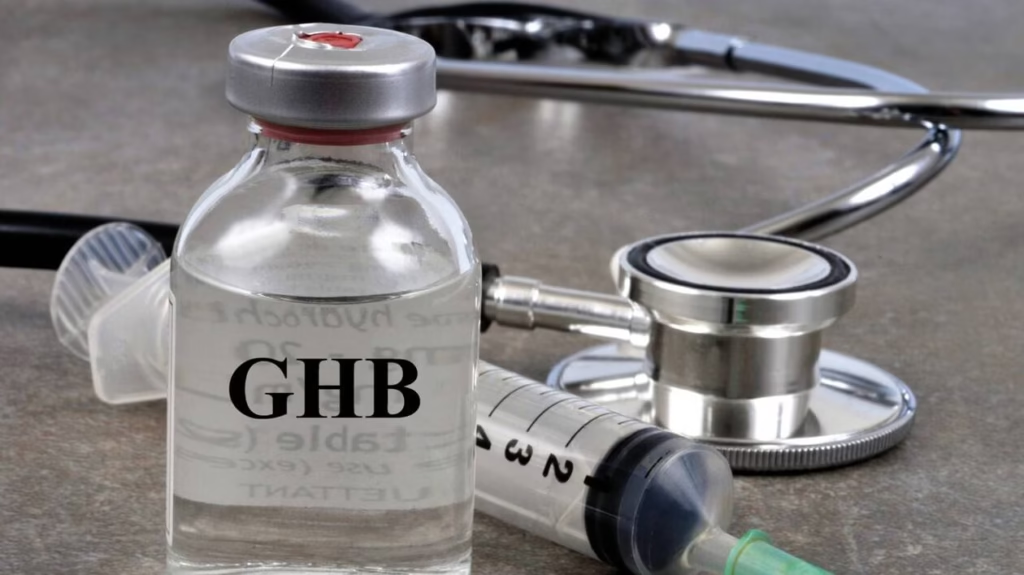
Canada’s GHB laws are among the strictest in the Western world. Under the Controlled Drugs and Substances Act (CDSA), GHB is classified as a Schedule I controlled substance— the highest restriction tier in Canadian drug law — placing it in the same legal category as heroin, cocaine, and fentanyl. Any unauthorized possession, trafficking, production, importation, or exportation of GHB is a serious criminal offence carrying penalties that range from heavy fines to life imprisonment.
The Governing Law: Canada’s CDSA
What Is the Controlled Drugs and Substances Act?
The Controlled Drugs and Substances Act (CDSA), enacted in 1996, is the primary federal legislation that governs all controlled substances in Canada. It consolidates Canada’s drug laws into a single statute, organizing controlled substances into Schedules I through VIII, with Schedule I carrying the heaviest criminal consequences.
The CDSA applies uniformly across all provinces and territories — there are no provincial opt-outs or municipal exceptions. This means GHB laws apply equally whether you are in Toronto, Vancouver, Montreal, Calgary, or any remote community in northern Canada. Enforcement is carried out by the Royal Canadian Mounted Police (RCMP), provincial police forces, and municipal law enforcement agencies.
GHB’s Schedule I Classification
GHB was officially elevated to Schedule I of the CDSA on November 6, 2012, upgraded from its prior Schedule III status. This reclassification was driven by documented cases of GHB abuse, its widespread use in drug-facilitated sexual assault (DFSA), and growing evidence of its addiction and overdose potential.
Schedule I substances under Canadian law include:
- Heroin (diacetylmorphine)
- Cocaine and crack cocaine
- Fentanyl and analogues
- Methamphetamine
- MDMA (ecstasy)
- GHB (gamma-hydroxybutyrate / gamma-hydroxybutyric acid)
GHB Possession Laws in Canada
Is Possessing GHB a Crime?
Yes. Under Section 4 of the CDSA, simple possession of a Schedule I substance — including GHB — without lawful authority is a criminal offence. There is no minimum quantity threshold, no personal-use exemption, and no provision for “social supply.” Even carrying a small amount of GHB for personal consumption is fully prosecutable under Canadian law.
Possession Penalties
GHB possession offences can be prosecuted either by summary conviction (less serious) or indictment (more serious), depending on the circumstances:
Aggravating factors — such as possession near a school, in the presence of a minor, or in connection with organized crime — can push a possession charge toward indictment and result in significantly harsher sentences.
Impact of a GHB Possession Conviction
Beyond incarceration, a GHB-related criminal conviction in Canada carries long-lasting consequences:
- A permanent criminal record visible to employers and licensing bodies
- Inadmissibility to foreign countries, particularly the United States, which denies entry to individuals convicted of drug offences
- Loss of certain professional licences in regulated industries (healthcare, law, finance, education)
- Impact on immigration status for non-citizens, including potential deportation
GHB Trafficking Laws in Canada
What Counts as Trafficking?
Under the CDSA, trafficking is broadly defined and includes:
- Selling or offering to sell GHB
- Giving GHB to another person, even for free
- Administering GHB to someone else
- Transporting GHB for the purpose of distribution
- Possession of GHB with intent to traffic (even without an observed transaction)
Trafficking Penalties
GHB trafficking is prosecuted as an indictable offence and is treated with the same severity as heroin or cocaine trafficking under Canadian law:
- Maximum sentence: Life imprisonment
- Mandatory minimum: 1 year imprisonment where aggravating factors are present
Aggravating factors that trigger mandatory minimums include:
- Trafficking near a school, playground, or public space frequented by minors
- Involvement of a youth (under 18) in the trafficking operation
- Prior drug trafficking conviction within the past 10 years
- Use of a weapon or violence
- Connections to organized crime
Possession for the purpose of trafficking (POPT) carries the same penalties as trafficking itself — meaning police do not need to witness you selling GHB, only establish through evidence (quantity, packaging, scales, cash) that you intended to do so.
GHB Import and Export Laws
Bringing GHB Into or Out of Canada
The importation and exportation of GHB is a distinct criminal offence under Section 6 of the CDSA and is aggressively enforced by the Canada Border Services Agency (CBSA).
Penalties for GHB importation or exportation:
- Mandatory minimum: 1 year imprisonment
- Mandatory minimum: 2 years where the quantity involved exceeds 1 kilogram
- Maximum: Life imprisonment
Attempting to import GHB — whether concealed in luggage at an airport, mailed through a courier service, or driven across a land border — is treated as a serious federal crime. The CBSA uses X-ray scanning, drug-detection dogs, chemical testing, and intelligence-based profiling to identify controlled substance shipments at all Canadian ports of entry.
GHB Precursor Laws in Canada
GBL and 1,4-Butanediol Controls
A significant component of Canada’s GHB laws covers chemical precursors — substances that are converted into GHB once ingested or synthesized. The two most commonly encountered GHB precursors are:
- GBL (gamma-butyrolactone) — An industrial solvent that rapidly metabolizes into GHB in the human body
- 1,4-Butanediol (1,4-BD) — A chemical compound that similarly converts to GHB after consumption
Both GBL and 1,4-BD are classified as Class A Precursors under the CDSA’s Precursor Control Regulations. Any person or business seeking to import or export these chemicals must hold a valid federal licence and permit issued by Health Canada.
Why Canada Controls GHB Precursors
The precursor control framework was introduced following documented cases of individuals circumventing GHB restrictions by importing GBL as an “industrial cleaner.” Canadian law enforcement and Health Canada treat this as a deliberate attempt to exploit a loophole, and courts have consistently treated such cases as GHB-equivalent offences.
GHB Medical Use Laws in Canada
Is GHB Ever Legal in Canada?
Yes — within a tightly controlled framework. Sodium oxybate, the pharmaceutical-grade form of GHB, is legally available in Canada under the brand name Xyrem for the treatment of narcolepsy. Specifically, Xyrem is prescribed to manage:
- Cataplexy — sudden involuntary muscle weakness triggered by emotion
- Excessive daytime sleepiness (EDS) associated with narcolepsy
Xyrem is classified as one of the most regulated prescription drugs in Canada. It is distributed through an exclusive, controlled distribution program, with prescriptions requiring specialist involvement (typically a neurologist or sleep medicine physician), patient registration, and ongoing compliance monitoring.
Critically: Possessing Xyrem without a valid prescription, or diverting prescribed Xyrem for recreational use, is still a criminal offence under the CDSA. The medical exemption applies only to the prescription holder under the specific authorized therapeutic use.
GHB and Drug-Facilitated Sexual Assault Laws
Canada’s GHB laws are inseparable from its legal response to drug-facilitated sexual assault (DFSA). Administering GHB to another person without their knowledge or consent for any purpose — let alone sexual assault — triggers prosecution under both the CDSA and the Criminal Code of Canada, resulting in cumulative charges and substantially longer sentences.
GHB’s properties that make it particularly dangerous in DFSA contexts include:
- Colourless and nearly odourless — dissolves invisibly into beverages
- Fast-acting — effects begin within 15–30 minutes of ingestion
- Potent amnesia-inducing — victims frequently have no memory of events
- Extremely dangerous with alcohol — the combination dramatically amplifies sedation and overdose risk
- Short detection window — GHB metabolizes rapidly, complicating forensic evidence collection
Canadian police services have specialized DFSA investigation units trained in time-sensitive GHB toxicology testing, and courts treat DFSA cases as priority prosecutions.
Provincial Enforcement of GHB Laws
While GHB laws are federal, provincial enforcement priorities and resources vary. Key enforcement considerations by region include:
- British Columbia: Home to Canada’s most active harm reduction programs, but GHB remains fully illegal; BC decriminalization (2023–2024) applied only to certain substances and did not include GHB
- Ontario: RCMP and Ontario Provincial Police (OPP) actively enforce CDSA Schedule I drug laws, with Toronto Police Service running dedicated drug squad units
- Quebec: Sûreté du Québec enforces federal drug laws consistently; GHB charges in nightlife and entertainment venues have been prosecuted in Montreal
- Alberta: RCMP and municipal forces maintain aggressive enforcement against club drugs including GHB
No province or territory in Canada has moved to decriminalize, deprioritize, or reduce enforcement of GHB — reinforcing that GHB remains uniformly illegal nationwide.
GHB Laws: Canada vs. International Comparison
Canada’s GHB laws are among the most punitive globally, with life imprisonment possible for trafficking — a maximum sentence not available under UK or German GHB legislation.
Getting Help: GHB Addiction Resources in Canada
GHB dependency is physically dangerous. Withdrawal symptoms — including tremors, sweating, severe anxiety, hallucinations, and seizures — can be life-threatening and require medical supervision. If you or someone you know is struggling with GHB use, the following Canadian resources provide confidential help:
- CAMH (Centre for Addiction and Mental Health) — Canada’s leading addiction hospital and research centre
- Here to Help BC — Province-wide substance use education and support
- Health Canada Substance Use Services — Federal directory of treatment programs and harm reduction services
- Crisis Services Canada — Free 24/7 crisis intervention and referral services
- Canadian Centre on Substance Use and Addiction (CCSA) — National research and policy body for substance use